NASA Space Apps Challenge · Lucerne · Starlab Challenge
Halo
A wearable resistance exoskeleton together with a mental-health companion that share one data loop, built for the commercial stations that come after the ISS.
Astronauts endure extreme isolation. Then microgravity forces them to train just to survive. Every hour spent fighting their own bodies is an hour stolen from what actually matters.
20 %
of muscle mass
gone in as little as 5 to 11 days in orbit
1 %
of bone density
lost every single month, over ten times faster than severe osteoporosis
2 h+
of exercise
every day, just to slow it down — time stolen from the mission
60 %+
severe psychological incidents
annual incidence on missions beyond 600 days
Our Solution




One dashboard. Body and mind.
Mental score, sleep and sentiment — right next to live load, heart rate and breathing from the exoskeleton. Nobody has to go hunting for data any more.

Mental health that adapts
A short evaluation every day. Tomorrow’s questions are generated from today’s answers by a model that runs on the station. No connection to Earth is required.
- Trends instead of snapshots: sleep, sentiment, reaction time
- A direct line to the flight surgeon on Earth — with evaluated data, not a feeling
- The Companion is awake at 03:00 station time, when nobody else is
Impact: isolation, monotony and broken sleep cost reaction time and judgement — the two things a crew cannot afford to lose. Halo M sees the slide before the crew feels it.

Strength training you wear
An exoskeleton with electromagnetically controlled resistance. It loads exactly the muscles that disappear in weightlessness — while the crew does its normal work.
- Resistance set per joint from the app, with an adaptive training plan
- Sensing on board: PPG, ECG, EDA, skin temperature, respiration
- Replaces room-sized hardware like ARED — buys back time, mass and volume
Impact: up to 20 % of muscle mass in 5–11 days, 1 % of bone every month, 2+ hours of exercise a day. Halo P takes that time back and keeps the loading going.
Why an exoskeleton — and why nobody has built this one yet.
Resistance training is the only thing that stops muscle and bone loss in orbit, and today it takes room-sized hardware like ARED and two hours a day. NASA's X1 proved a wearable could do it — then never left the prototype stage, without adaptation or a feedback loop. Halo P picks that thread back up: loading you wear while you work.
Quasi Direct Drive actuators
Backdrivable, efficient and robust — already proven in exoskeletons, some of them designed for space from the start. The suit moves with the crew instead of fighting them.
Resistance from electromagnetism
Load is set per joint in the app rather than by hardware, so the training plan can adapt day by day — and shrink on the days the mission needs the time.
A motor-driven artificial spine
A rope mechanism emulates G-load and spinal compression — the one thing microgravity takes away and no treadmill gives back.
Sensors in the frame
PPG, ECG, EDA/GSR, skin temperature and respiration. An ESP32 on a small PCB keeps the suit and the app in sync — and the same stream feeds Halo M.
Aluminium or titanium rods, Velcro straps, joints built for full range of motion — so it feels like clothing, not machinery. Every part exists today; the innovation is in putting them together.
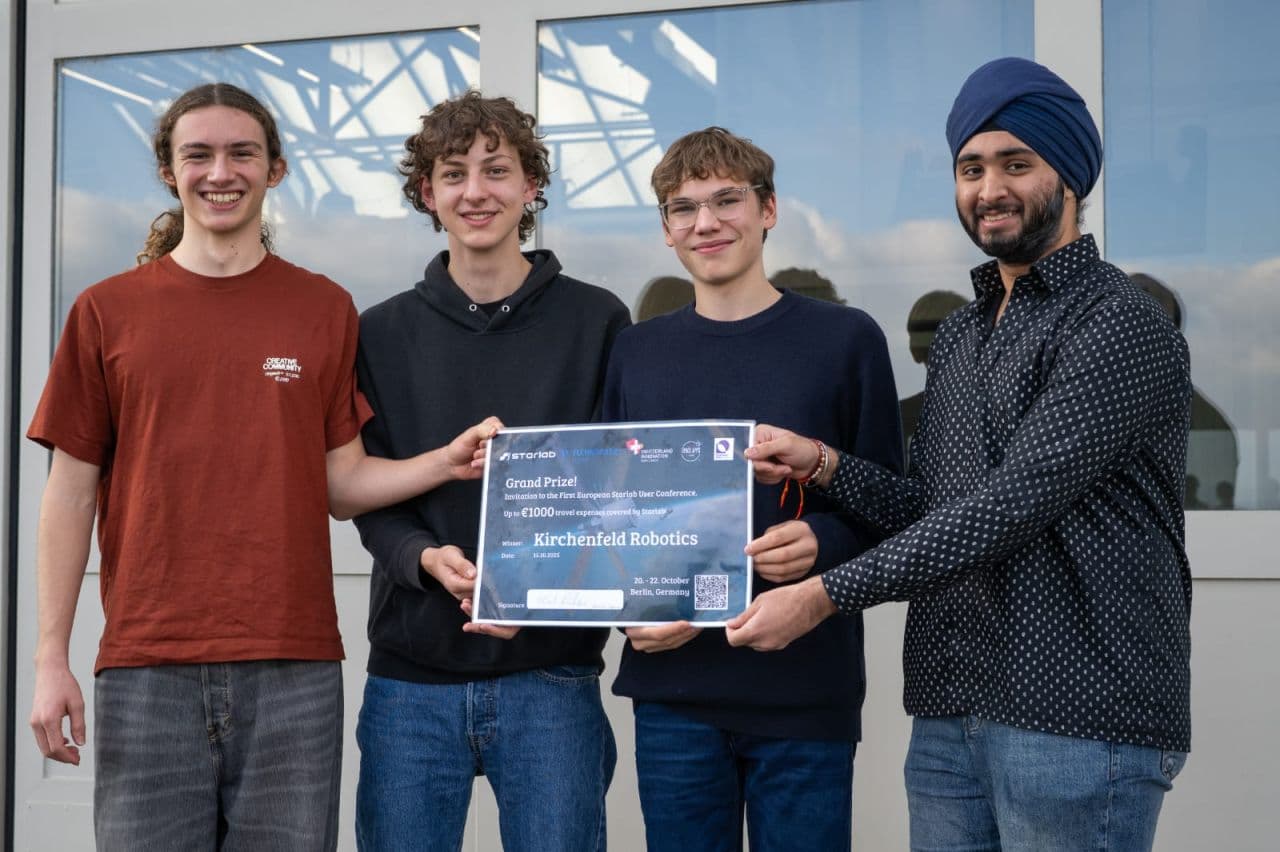
1st placeKirchenfeldrobotics
Invitation to Starlab's User Interface Conference in Berlin.